

Some of us may be familiar with Tuckman’s stages of group development—Forming, Storming, Norming, and Performing—a powerful model explaining how teams evolve. Yet we rarely see frameworks telling us who to put on those teams—and when.
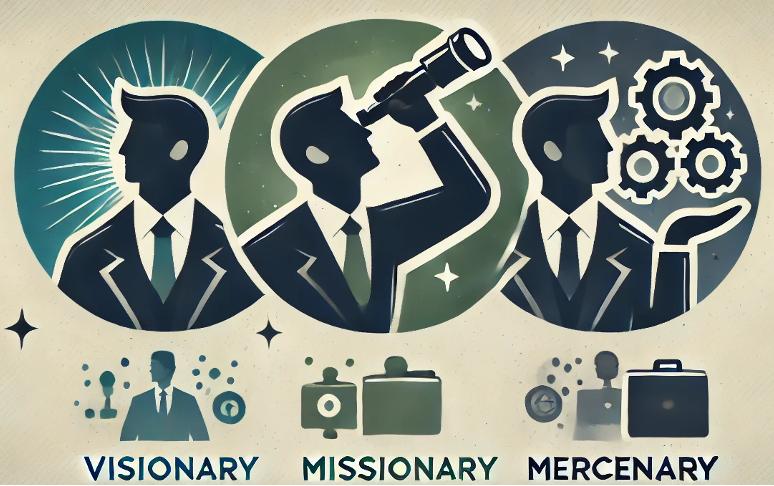
That’s why I’m excited to introduce the Growth Archetypes Framework: a practical, system-based approach that addresses the question of who to hire (and when), and how to deploy them effectively. This model can be applied to entire organizations, specific business units within a larger company, or even specialized roles supporting different system functions. It aligns three core archetypes—Visionaries, Missionaries, and Mercenaries—with each stage of organizational growth. By pairing these archetypes with specific character strengths, we can more intentionally assemble teams that meet the evolving demands of a startup, scaling venture, or a mature SME focused primarily on execution.
If you’ve ever wondered:
“Is our current team composition right for where we are?”
“Who do we need next to fuel our growth?”
This framework will offer clarity.
What Makes This Framework Different?
Tuckman’s model focuses on how team dynamics shift over time. The Growth Archetypes Framework zeroes in on who belongs in the room, when—and with which key strengths. It combines:
Role Archetypes: Visionaries, Missionaries, and Mercenaries
Character Strengths: Based on the science-backed 24 VIA Character Strengths
Growth Stage Alignment: Matching talent and strengths to the current phase of your organization
By pinpointing critical roles and strengths, you’ll have a clear roadmap for recruiting, promoting, and reorganizing teams at each growth stage.
The Three Growth Archetypes
1. Visionaries – The Dreamers
Role: Define the future, spark big ideas, and map out strategic possibilities.
Most Valuable VIA Strengths:
Creativity (original thinking, problem-solving)
Curiosity (driving exploration of new ideas)
Perspective (seeing the big picture)
Love of Learning (constant acquisition of knowledge)
Risk: Too many Visionaries can lead to endless brainstorming without tangible results.
2. Missionaries – The Believers
Role: Commit deeply to the mission and do the heavy lifting that turns vision into reality.
Most Valuable VIA Strengths:
Perseverance (grit to overcome obstacles)
Teamwork (collaboration, unity)
Kindness (supporting and empowering colleagues)
Social Intelligence (navigating relationships and group dynamics)
Risk: If the team is full of Missionaries, burnout and “change fatigue” can set in, leading to resistance when new directions arise.
3. Mercenaries – The Executors
Role: Deliver results, optimize operations, and refine processes for efficiency at scale.
Most Valuable VIA Strengths:
Leadership (driving groups to shared goals)
Prudence (risk-aware, measured decision-making)
Self-Regulation (discipline and focus)
Zest (enthusiasm that propels action)
Risk: Bringing in Mercenaries too early can stifle creative exploration and lead to over-optimizing before product-market fit.

Who’s Vital: Visionaries for strategic direction, Missionaries for building culture and momentum.
Watch Out: Bringing in Mercenaries too soon can lead to premature optimization and losing out on creative breakthroughs.
Scale-Up Phase
Who’s Vital: Missionaries preserve cultural DNA; Mercenaries establish scalable processes; Visionaries guide from a more advisory or high-level role.
Key Balance: Grow efficiently without losing the spark that fueled early success.
Mature Phase
This stage covers a broad spectrum—from large enterprises to established SMEs (small and medium-sized enterprises) focused primarily on execution. Here, Mercenaries typically drive day-to-day efficiency, while Missionaries sustain cultural continuity and Visionaries encourage incremental improvements or future opportunities.
Who’s Vital: Mercenaries for operational excellence; Missionaries to preserve the cultural heartbeat; Visionaries to fuel ongoing innovation—even if modest.
Special Note for Mature SMEs: If an SME’s priority is execution above all else, the framework ensures you don’t lose touch with the underlying culture and occasional need for fresh ideas. While Mercenaries may lead in this environment, it’s still worth maintaining at least a spark of visionary thinking.
Danger Zone: Losing Missionaries can erode culture; sidelining Visionaries risks stagnation—even if growth goals appear stable.
Why Character Strengths Matter
The VIA Institute’s 24 Character Strengths provide a research-backed lens for pinpointing where each individual naturally excels. Mapping these strengths to the right archetype can supercharge both team performance and personal fulfillment.
Pro Tip: Have your team (including you) take the free VIA Character Strengths Survey and compare results. Are your team members set up for success in roles that align with their top strengths?
Implementing the Growth Archetypes Framework
Assess Your Team
Identify each member’s likely archetype.
Check whether their VIA strengths match the role they’re playing.
Strategically Evolve
Adjust responsibilities, bring on new hires, or promote people into roles aligned with your current growth stage.
Ensure each archetype is supported by complementary strengths.
Reassess Regularly
Teams and companies aren’t static.
At major milestones or pivots, re-map roles and strengths to keep pace with evolving needs.
Reflection
Ask yourself: What stage is my business in right now? Do you have the right balance of Visionaries, Missionaries, and Mercenaries for this moment? Are their individual character strengths supporting or hindering your organization’s goals?
When archetypes and strengths align, momentum accelerates and friction disappears—without losing the essence that made your team special in the first place.
Call to Action
This week, try the following:
Map your team to the Growth Archetypes Framework.
Share the VIA Strengths Survey so everyone knows their top strengths.
Plan next steps for alignment or new hires based on your current growth stage—and the one around the corner.
If this framework helps, please forward it to a colleague or founder crafting their dream team. If you'd like to dive deeper into these concepts in a structured way, I'd love your feedback on whether a dedicated course or workshop would be valuable.
Thanks for reading. Here’s to building stronger, more aligned teams at every stage!
— Shaune Reynolds